AI Chatbot Free

AI Chatbot Free — independent reviews, comparisons, pricing and step-by-step guides on Aizhi.

  • Escapex

    Escapex

    Escapex, stylized as escapex, was a mobile app developer specializing in white-label fan engagement apps for celebrities. It was founded by Sephi Shapira in 2014 and has raised $18 million in funding. It allows celebrities to reach fans directly, as well as receiving revenue from fans through its freemium model. == Overview == Shapira is Israeli and previously founded Interchan and MassiveImpact. He graduated from Ben-Gurion University of the Negev. The company has raised $18 million in funding. Its 2018 revenue was $5.5 million. In 2016, the company had 57 employees split between Tel Aviv and New York City. The company's General Manager is Joe Cuello, formerly an executive at MTV, then Chief Creative Officer at TuneCore. Their director of social engagement is Rafe Lopresti-Oakes. A press release from the company described the service as having a "proprietary loyalty program" which allows "monetization of social engagement through e-commerce and in-app advertising". App launches typically offered a contest for one fan to meet the celebrity. The app also allows Escapex to collect and monetize user profiles for advertising. The New York Times described the concept of Escapex, musing, "If people love you, why not make money from them?". == Notable apps == The company has created over 350 applications, including: Enrique Iglesias, June 2016 or earlier Akon, June 2016 or earlier Ricky Martin, June 2016 or earlier Rohan Marley and the Bob Marley estate, February 2017 Marc Anthony, March 2017 Prince Royce, March 2017 Jeremy Renner, March 2017, making over $35,000 per month in April 2019 Galen Gering, June 2017 Yandel, June 2017 Greg Vaughan, June 2017 Jason Thompson, June 2017 Niecy Nash, September 2017 Tyler Posey, September 2017 Osric Chau, January 2018 Chris D'Elia Alessandra Ambrosio, making over $35,000 per month in April 2019 Abigail Ratchford, making over $35,000 per month in April 2019 Amber Rose, making over $35,000 per month in April 2019 Dita Von Teese Tommy Chong === Bollywood stars === Escapex has a large roster of Bollywood celebrities, including: Sunny Leone, December 2016 Remo D'Souza, January 2017 Amy Jackson, March 2017 Kajal Aggarwal, March 2017 Nargis Fakhri, April 2017 Disha Patani Sonam Kapoor Salman Khan == Jeremy Renner app == Renner released a mobile app called "Jeremy Renner" (Android) and "Jeremy Renner Official" (iOS) in March 2017. FastCompany wrote extensively about Renner's app in April 2019, calling it "a surprising new kind of social media". The Ringer's Kate Knibbs, explaining how self-referential the app is, summarized it stating "Jeremy Renner’s Jeremy Renner app is the Jeremy Renner of apps." The community developed to include memes, selfies, and a "Happy Rennsday" event on Wednesdays. As early as October 2017 there were claims of censorship, bullying, and "contest-rigging". In September 2019, comedian Stefan Heck wrote about discovering that any replies through the app would appear as if they were sent by Renner himself in push notifications. Heck wrote about notifications making it appear Renner was a big enthusiast of "porno"; other users made it appear Renner was a big fan of Casey Anthony. Renner had to ask Escapex to shut down the app the following day, stating "The app has jumped the shark. Literally." In September 2020, comedian/writer Caroline Goldfarb and actress Sarah Ramos launched The Renner Files podcast, a six-part series investigating the Jeremy Renner app.

    Read more →
  • Concept drift

    Concept drift

    In predictive analytics, data science, machine learning and related fields, concept drift or drift is an evolution of data that invalidates the data model. It happens when the statistical properties of the target variable, which the model is trying to predict, change over time in unforeseen ways. This causes problems because the predictions become less accurate as time passes. Drift detection and drift adaptation are of paramount importance in the fields that involve dynamically changing data and data models. == Predictive model decay == In machine learning and predictive analytics this drift phenomenon is called concept drift. In machine learning, a common element of a data model are the statistical properties, such as probability distribution of the actual data. If they deviate from the statistical properties of the training data set, then the learned predictions may become invalid, if the drift is not addressed. == Data configuration decay == Another important area is software engineering, where three types of data drift affecting data fidelity may be recognized. Changes in the software environment ("infrastructure drift") may invalidate software infrastructure configuration. "Structural drift" happens when the data schema changes, which may invalidate databases. "Semantic drift" is changes in the meaning of data while the structure does not change. In many cases this may happen in complicated applications when many independent developers introduce changes without proper awareness of the effects of their changes in other areas of the software system. For many application systems, the nature of data on which they operate are subject to changes for various reasons, e.g., due to changes in business model, system updates, or switching the platform on which the system operates. In the case of cloud computing, infrastructure drift that may affect the applications running on cloud may be caused by the updates of cloud software. There are several types of detrimental effects of data drift on data fidelity. Data corrosion is passing the drifted data into the system undetected. Data loss happens when valid data are ignored due to non-conformance with the applied schema. Squandering is the phenomenon when new data fields are introduced upstream in the data processing pipeline, but somewhere downstream these data fields are absent. == Inconsistent data == "Data drift" may refer to the phenomenon when database records fail to match the real-world data due to the changes in the latter over time. This is a common problem with databases involving people, such as customers, employees, citizens, residents, etc. Human data drift may be caused by unrecorded changes in personal data, such as place of residence or name, as well as due to errors during data input. "Data drift" may also refer to inconsistency of data elements between several replicas of a database. The reasons can be difficult to identify. A simple drift detection is to run checksum regularly. However the remedy may be not so easy. == Examples == The behavior of the customers in an online shop may change over time. For example, if weekly merchandise sales are to be predicted, and a predictive model has been developed that works satisfactorily. The model may use inputs such as the amount of money spent on advertising, promotions being run, and other metrics that may affect sales. The model is likely to become less and less accurate over time – this is concept drift. In the merchandise sales application, one reason for concept drift may be seasonality, which means that shopping behavior changes seasonally. Perhaps there will be higher sales in the winter holiday season than during the summer, for example. Concept drift generally occurs when the covariates that comprise the data set begin to explain the variation of your target set less accurately — there may be some confounding variables that have emerged, and that one simply cannot account for, which renders the model accuracy to progressively decrease with time. Generally, it is advised to perform health checks as part of the post-production analysis and to re-train the model with new assumptions upon signs of concept drift. == Possible remedies == To prevent deterioration in prediction accuracy because of concept drift, reactive and tracking solutions can be adopted. Reactive solutions retrain the model in reaction to a triggering mechanism, such as a change-detection test or control charts from statistical process control, to explicitly detect concept drift as a change in the statistics of the data-generating process. When concept drift is detected, the current model is no longer up-to-date and must be replaced by a new one to restore prediction accuracy. A shortcoming of reactive approaches is that performance may decay until the change is detected. Tracking solutions seek to track the changes in the concept by continually updating the model. Methods for achieving this include online machine learning, frequent retraining on the most recently observed samples, and maintaining an ensemble of classifiers where one new classifier is trained on the most recent batch of examples and replaces the oldest classifier in the ensemble. Contextual information, when available, can be used to better explain the causes of the concept drift: for instance, in the sales prediction application, concept drift might be compensated by adding information about the season to the model. By providing information about the time of the year, the rate of deterioration of your model is likely to decrease, but concept drift is unlikely to be eliminated altogether. This is because actual shopping behavior does not follow any static, finite model. New factors may arise at any time that influence shopping behavior, the influence of the known factors or their interactions may change. Concept drift cannot be avoided for complex phenomena that are not governed by fixed laws of nature. All processes that arise from human activity, such as socioeconomic processes, and biological processes are likely to experience concept drift. Therefore, periodic retraining, also known as refreshing, of any model is necessary. === Remedy methods === DDM (Drift Detection Method): detects drift by monitoring the model's error rate over time. When the error rate passes a set threshold, it enters a warning phase, and if it passes another threshold, it enters a drift phase. EDDM (Early Drift Detection Method): improves DDM's detection rate by tracking the average distance between two errors instead of only the error rate. ADWIN (Adaptive Windowing): dynamically stores a window of recent data and warns the user if it detects a significant change between the statistics of the window's earlier data compared to more recent data. KSWIN (Kolmogorov–Smirnov Windowing): detects drift based on the Kolmogorov-Smirnov statistical test. DDM and EDDM: Concept Drift Detection online supervised methods that rely on sequential error monitoring to estimate the evolving error rate. ADWIN and KSWIN: Windowing maintain a "window", a subset of the most recent data, of the data stream, which it checks for statistical differences across the window. == Applications in security == Concept drift is a recurring issue in security analytics, especially in malware and intrusion detection. In these systems, models are often trained on past logs, binaries or network traces, but the behaviour of attackers changes over time as new malware families, obfuscation techniques and campaigns appear. When the data no longer resemble the training set, the decision boundaries learned by classifiers or anomaly detectors can become misaligned with the current threat landscape and detection performance can drop unless the models are updated or replaced. Several studies on Windows malware model detection as an evolving data stream and track how performance changes as time passes. They show that classifiers trained on a fixed time window can perform well on nearby data but deteriorate quickly when evaluated on samples collected months or years later, even when large amounts of training data are available. In order to keep up with this, security systems often use sliding or adaptive windows, which restrict training to the most recent portion of the data so that older, less relevant examples are gradually discarded. They also employ drift detectors such as ADWIN and KSWIN that monitor error rates or changes in the distribution of recent observations and signal when the statistics of the incoming stream differ significantly from the past, prompting retraining or model replacement. Related problems appear in spam filtering, fraud detection and intrusion detection, where adversaries change content, patterns of activity or network behavior to evade models trained on historical data. In these settings drift can be gradual, as new types of spam or fraud emerge, or abrupt, after a sudden shift in attack techniques. Common strategies to remain eff

    Read more →
  • AIXI

    AIXI

    AIXI is a theoretical mathematical formalism for artificial general intelligence. It combines Solomonoff induction with sequential decision theory. AIXI was first proposed by Marcus Hutter in 2000 and several results regarding AIXI are proved in Hutter's 2005 book Universal Artificial Intelligence. AIXI is a reinforcement learning (RL) agent. It maximizes the expected total rewards received from the environment. Intuitively, it simultaneously considers every computable hypothesis (or environment). In each time step, it looks at every possible program and evaluates how many rewards that program generates depending on the next action taken. The promised rewards are then weighted by the subjective belief that this program constitutes the true environment. This belief is computed from the length of the program: longer programs are considered less likely, in line with Occam's razor. AIXI then selects the action that has the highest expected total reward in the weighted sum of all these programs. == Etymology == According to Hutter, the word "AIXI" can have several interpretations. AIXI can stand for AI based on Solomonoff's distribution, denoted by ξ {\displaystyle \xi } (which is the Greek letter xi), or e.g. it can stand for AI "crossed" (X) with induction (I). There are other interpretations. == Definition == AIXI is a reinforcement learning agent that interacts with some stochastic and unknown but computable environment μ {\displaystyle \mu } . The interaction proceeds in time steps, from t = 1 {\displaystyle t=1} to t = m {\displaystyle t=m} , where m ∈ N {\displaystyle m\in \mathbb {N} } is the lifespan of the AIXI agent. At time step t, the agent chooses an action a t ∈ A {\displaystyle a_{t}\in {\mathcal {A}}} (e.g. a limb movement) and executes it in the environment, and the environment responds with a "percept" e t ∈ E = O × R {\displaystyle e_{t}\in {\mathcal {E}}={\mathcal {O}}\times \mathbb {R} } , which consists of an "observation" o t ∈ O {\displaystyle o_{t}\in {\mathcal {O}}} (e.g., a camera image) and a reward r t ∈ R {\displaystyle r_{t}\in \mathbb {R} } , distributed according to the conditional probability μ ( o t r t | a 1 o 1 r 1 . . . a t − 1 o t − 1 r t − 1 a t ) {\displaystyle \mu (o_{t}r_{t}|a_{1}o_{1}r_{1}...a_{t-1}o_{t-1}r_{t-1}a_{t})} , where a 1 o 1 r 1 . . . a t − 1 o t − 1 r t − 1 a t {\displaystyle a_{1}o_{1}r_{1}...a_{t-1}o_{t-1}r_{t-1}a_{t}} is the "history" of actions, observations and rewards. The environment μ {\displaystyle \mu } is thus mathematically represented as a probability distribution over "percepts" (observations and rewards) which depend on the full history, so there is no Markov assumption (as opposed to other RL algorithms). Note again that this probability distribution is unknown to the AIXI agent. Furthermore, note again that μ {\displaystyle \mu } is computable, that is, the observations and rewards received by the agent from the environment μ {\displaystyle \mu } can be computed by some program (which runs on a Turing machine), given the past actions of the AIXI agent. The only goal of the AIXI agent is to maximize ∑ t = 1 m r t {\displaystyle \sum _{t=1}^{m}r_{t}} , that is, the sum of rewards from time step 1 to m. The AIXI agent is associated with a stochastic policy π : ( A × E ) ∗ → A {\displaystyle \pi :({\mathcal {A}}\times {\mathcal {E}})^{}\rightarrow {\mathcal {A}}} , which is the function it uses to choose actions at every time step, where A {\displaystyle {\mathcal {A}}} is the space of all possible actions that AIXI can take and E {\displaystyle {\mathcal {E}}} is the space of all possible "percepts" that can be produced by the environment. The environment (or probability distribution) μ {\displaystyle \mu } can also be thought of as a stochastic policy (which is a function): μ : ( A × E ) ∗ × A → E {\displaystyle \mu :({\mathcal {A}}\times {\mathcal {E}})^{}\times {\mathcal {A}}\rightarrow {\mathcal {E}}} , where the ∗ {\displaystyle } is the Kleene star operation. In general, at time step t {\displaystyle t} (which ranges from 1 to m), AIXI, having previously executed actions a 1 … a t − 1 {\displaystyle a_{1}\dots a_{t-1}} (which is often abbreviated in the literature as a < t {\displaystyle a_{ Read more →

  • Case-based reasoning

    Case-based reasoning

    Case-based reasoning (CBR), broadly construed, is the process of solving new problems based on the solutions of similar past problems. In everyday life, an auto mechanic who fixes an engine by recalling another car that exhibited similar symptoms is using case-based reasoning. A lawyer who advocates a particular outcome in a trial based on legal precedents or a judge who creates case law is using case-based reasoning. So, too, an engineer copying working elements of nature (practicing biomimicry) is treating nature as a database of solutions to problems. Case-based reasoning is a prominent type of analogy solution making. It has been argued that case-based reasoning is not only a powerful method for computer reasoning, but also a pervasive behavior in everyday human problem solving; or, more radically, that all reasoning is based on past cases personally experienced. This view is related to prototype theory, which is most deeply explored in cognitive science. == Process == Case-based reasoning has been formalized for purposes of computer reasoning as a four-step process: Retrieve: Given a target problem, retrieve cases relevant to solving it from memory. A case consists of a problem, its solution, and, typically, annotations about how the solution was derived. For example, suppose Fred wants to prepare blueberry pancakes. Being a novice cook, the most relevant experience he can recall is one in which he successfully made plain pancakes. The procedure he followed for making the plain pancakes, together with justifications for decisions made along the way, constitutes Fred's retrieved case. Reuse: Map the solution from the previous case to the target problem. This may involve adapting the solution as needed to fit the new situation. In the pancake example, Fred must adapt his retrieved solution to include the addition of blueberries. Revise: Having mapped the previous solution to the target situation, test the new solution in the real world (or a simulation) and, if necessary, revise. Suppose Fred adapted his pancake solution by adding blueberries to the batter. After mixing, he discovers that the batter has turned blue – an undesired effect. This suggests the following revision: delay the addition of blueberries until after the batter has been ladled into the pan. Retain: After the solution has been successfully adapted to the target problem, store the resulting experience as a new case in memory. Fred, accordingly, records his new-found procedure for making blueberry pancakes, thereby enriching his set of stored experiences, and better preparing him for future pancake-making demands. == Comparison to other methods == At first glance, CBR may seem similar to the rule induction algorithms of machine learning. Like a rule-induction algorithm, CBR starts with a set of cases or training examples; it forms generalizations of these examples, albeit implicit ones, by identifying commonalities between a retrieved case and the target problem. If for instance a procedure for plain pancakes is mapped to blueberry pancakes, a decision is made to use the same basic batter and frying method, thus implicitly generalizing the set of situations under which the batter and frying method can be used. The key difference, however, between the implicit generalization in CBR and the generalization in rule induction lies in when the generalization is made. A rule-induction algorithm draws its generalizations from a set of training examples before the target problem is even known; that is, it performs eager generalization. For instance, if a rule-induction algorithm were given recipes for plain pancakes, Dutch apple pancakes, and banana pancakes as its training examples, it would have to derive, at training time, a set of general rules for making all types of pancakes. It would not be until testing time that it would be given, say, the task of cooking blueberry pancakes. The difficulty for the rule-induction algorithm is in anticipating the different directions in which it should attempt to generalize its training examples. This is in contrast to CBR, which delays (implicit) generalization of its cases until testing time – a strategy of lazy generalization. In the pancake example, CBR has already been given the target problem of cooking blueberry pancakes; thus it can generalize its cases exactly as needed to cover this situation. CBR therefore tends to be a good approach for rich, complex domains in which there are myriad ways to generalize a case. In law, there is often explicit delegation of CBR to courts, recognizing the limits of rule based reasons: limiting delay, limited knowledge of future context, limit of negotiated agreement, etc. While CBR in law and cognitively inspired CBR have long been associated, the former is more clearly an interpolation of rule based reasoning, and judgment, while the latter is more closely tied to recall and process adaptation. The difference is clear in their attitude toward error and appellate review. Another name for case-based reasoning in problem solving is symptomatic strategies. It does require à priori domain knowledge that is gleaned from past experience which established connections between symptoms and causes. This knowledge is referred to as shallow, compiled, evidential, history-based as well as case-based knowledge. This is the strategy most associated with diagnosis by experts. Diagnosis of a problem transpires as a rapid recognition process in which symptoms evoke appropriate situation categories. An expert knows the cause by virtue of having previously encountered similar cases. Case-based reasoning is the most powerful strategy, and that used most commonly. However, the strategy won't work independently with truly novel problems, or where deeper understanding of whatever is taking place is sought. An alternative approach to problem solving is the topographic strategy which falls into the category of deep reasoning. With deep reasoning, in-depth knowledge of a system is used. Topography in this context means a description or an analysis of a structured entity, showing the relations among its elements. Also known as reasoning from first principles, deep reasoning is applied to novel faults when experience-based approaches aren't viable. The topographic strategy is therefore linked to à priori domain knowledge that is developed from a more a fundamental understanding of a system, possibly using first-principles knowledge. Such knowledge is referred to as deep, causal or model-based knowledge. Hoc and Carlier noted that symptomatic approaches may need to be supported by topographic approaches because symptoms can be defined in diverse terms. The converse is also true – shallow reasoning can be used abductively to generate causal hypotheses, and deductively to evaluate those hypotheses, in a topographical search. == Criticism == Critics of CBR argue that it is an approach that accepts anecdotal evidence as its main operating principle. Without statistically relevant data for backing and implicit generalization, there is no guarantee that the generalization is correct. However, all inductive reasoning where data is too scarce for statistical relevance is inherently based on anecdotal evidence. == History == CBR traces its roots to the work of Roger Schank and his students at Yale University in the early 1980s. Schank's model of dynamic memory was the basis for the earliest CBR systems: Janet Kolodner's CYRUS and Michael Lebowitz's IPP. Other schools of CBR and closely allied fields emerged in the 1980s, which directed at topics such as legal reasoning, memory-based reasoning (a way of reasoning from examples on massively parallel machines), and combinations of CBR with other reasoning methods. In the 1990s, interest in CBR grew internationally, as evidenced by the establishment of an International Conference on Case-Based Reasoning in 1995, as well as European, German, British, Italian, and other CBR workshops. CBR technology has resulted in the deployment of a number of successful systems, the earliest being Lockheed's CLAVIER, a system for laying out composite parts to be baked in an industrial convection oven. CBR has been used extensively in applications such as the Compaq SMART system and has found a major application area in the health sciences, as well as in structural safety management. There is recent work that develops CBR within a statistical framework and formalizes case-based inference as a specific type of probabilistic inference. Thus, it becomes possible to produce case-based predictions equipped with a certain level of confidence. One description of the difference between CBR and induction from instances is that statistical inference aims to find what tends to make cases similar while CBR aims to encode what suffices to claim similarly.

    Read more →
  • Information extraction

    Information extraction

    Information extraction (IE) is the task of automatically extracting structured information from unstructured and/or semi-structured machine-readable documents and other electronically represented sources. Typically, this involves processing human language texts by means of natural language processing (NLP). Recent activities in multimedia document processing like automatic annotation and content extraction out of images/audio/video/documents could be seen as information extraction. Recent advances in NLP techniques have allowed for significantly improved performance compared to previous years. An example is the extraction from newswire reports of corporate mergers, such as denoted by the formal relation: MergerBetween ⁡ ( c o m p a n y 1 , c o m p a n y 2 , d a t e ) {\displaystyle \operatorname {MergerBetween} (\mathrm {company} _{1},\mathrm {company} _{2},\mathrm {date} )} , from an online news sentence such as: "Yesterday, New York based Foo Inc. announced their acquisition of Bar Corp." A broad goal of IE is to allow computation to be done on the previously unstructured data. A more specific goal is to allow automated reasoning about the logical form of the input data. Structured data is semantically well-defined data from a chosen target domain, interpreted with respect to category and context. Information extraction is the part of a greater puzzle which deals with the problem of devising automatic methods for text management, beyond its transmission, storage and display. The discipline of information retrieval (IR) has developed automatic methods, typically of a statistical flavor, for indexing large document collections and classifying documents. Another complementary approach is that of natural language processing (NLP) which has solved the problem of modelling human language processing with considerable success when taking into account the magnitude of the task. In terms of both difficulty and emphasis, IE deals with tasks in between both IR and NLP. In terms of input, IE assumes the existence of a set of documents in which each document follows a template, i.e. describes one or more entities or events in a manner that is similar to those in other documents but differing in the details. An example, consider a group of newswire articles on Latin American terrorism with each article presumed to be based upon one or more terroristic acts. We also define for any given IE task a template, which is a(or a set of) case frame(s) to hold the information contained in a single document. For the terrorism example, a template would have slots corresponding to the perpetrator, victim, and weapon of the terroristic act, and the date on which the event happened. An IE system for this problem is required to "understand" an attack article only enough to find data corresponding to the slots in this template. == History == Information extraction dates back to the late 1970s in the early days of NLP. An early commercial system from the mid-1980s was JASPER built for Reuters by the Carnegie Group Inc with the aim of providing real-time financial news to financial traders. Beginning in 1987, IE was spurred by a series of Message Understanding Conferences. MUC is a competition-based conference that focused on the following domains: MUC-1 (1987), MUC-3 (1989): Naval operations messages. MUC-3 (1991), MUC-4 (1992): Terrorism in Latin American countries. MUC-5 (1993): Joint ventures and microelectronics domain. MUC-6 (1995): News articles on management changes. MUC-7 (1998): Satellite launch reports. Considerable support came from the U.S. Defense Advanced Research Projects Agency (DARPA), who wished to automate mundane tasks performed by government analysts, such as scanning newspapers for possible links to terrorism. == Present significance == The present significance of IE pertains to the growing amount of information available in unstructured form. Tim Berners-Lee, inventor of the World Wide Web, refers to the existing Internet as the web of documents and advocates that more of the content be made available as a web of data. Until this transpires, the web largely consists of unstructured documents lacking semantic metadata. Knowledge contained within these documents can be made more accessible for machine processing by means of transformation into relational form, or by marking-up with XML tags. An intelligent agent monitoring a news data feed requires IE to transform unstructured data into something that can be reasoned with. A typical application of IE is to scan a set of documents written in a natural language and populate a database with the information extracted. == Tasks and subtasks == Applying information extraction to text is linked to the problem of text simplification in order to create a structured view of the information present in free text. The overall goal being to create a more easily machine-readable text to process the sentences. Typical IE tasks and subtasks include: Template filling: Extracting a fixed set of fields from a document, e.g. extract perpetrators, victims, time, etc. from a newspaper article about a terrorist attack. Event extraction: Given an input document, output zero or more event templates. For instance, a newspaper article might describe multiple terrorist attacks. Knowledge Base Population: Fill a database of facts given a set of documents. Typically the database is in the form of triplets, (entity 1, relation, entity 2), e.g. (Barack Obama, Spouse, Michelle Obama) Named entity recognition: recognition of known entity names (for people and organizations), place names, temporal expressions, and certain types of numerical expressions, by employing existing knowledge of the domain or information extracted from other sentences. Typically the recognition task involves assigning a unique identifier to the extracted entity. A simpler task is named entity detection, which aims at detecting entities without having any existing knowledge about the entity instances. For example, in processing the sentence "M. Smith likes fishing", named entity detection would denote detecting that the phrase "M. Smith" does refer to a person, but without necessarily having (or using) any knowledge about a certain M. Smith who is (or, "might be") the specific person whom that sentence is talking about. Coreference resolution: detection of coreference and anaphoric links between text entities. In IE tasks, this is typically restricted to finding links between previously extracted named entities. For example, "International Business Machines" and "IBM" refer to the same real-world entity. If we take the two sentences "M. Smith likes fishing. But he doesn't like biking", it would be beneficial to detect that "he" is referring to the previously detected person "M. Smith". Relationship extraction: identification of relations between entities, such as: PERSON works for ORGANIZATION (extracted from the sentence "Bill works for IBM.") PERSON located in LOCATION (extracted from the sentence "Bill is in France.") Semi-structured information extraction which may refer to any IE that tries to restore some kind of information structure that has been lost through publication, such as: Table extraction: finding and extracting tables from documents. Table information extraction : extracting information in structured manner from the tables. This task is more complex than table extraction, as table extraction is only the first step, while understanding the roles of the cells, rows, columns, linking the information inside the table and understanding the information presented in the table are additional tasks necessary for table information extraction. Comments extraction : extracting comments from the actual content of articles in order to restore the link between authors of each of the sentences Language and vocabulary analysis Terminology extraction: finding the relevant terms for a given corpus Audio extraction Template-based music extraction: finding relevant characteristic in an audio signal taken from a given repertoire; for instance time indexes of occurrences of percussive sounds can be extracted in order to represent the essential rhythmic component of a music piece. Note that this list is not exhaustive and that the exact meaning of IE activities is not commonly accepted and that many approaches combine multiple sub-tasks of IE in order to achieve a wider goal. Machine learning, statistical analysis and/or natural language processing are often used in IE. IE on non-text documents is becoming an increasingly interesting topic in research, and information extracted from multimedia documents can now be expressed in a high level structure as it is done on text. This naturally leads to the fusion of extracted information from multiple kinds of documents and sources. == World Wide Web applications == IE has been the focus of the MUC conferences. The proliferation of the Web, however, intensified the need for developing IE systems that help people

    Read more →
  • Cross-validation (statistics)

    Cross-validation (statistics)

    Cross-validation, sometimes called rotation estimation or out-of-sample testing, is any of various similar model validation techniques for assessing how the results of a statistical analysis will generalize to an independent data set. Cross-validation includes resampling and sample splitting methods that use different portions of the data to test and train a model on different iterations. It is often used in settings where the goal is prediction, and one wants to estimate how accurately a predictive model will perform in practice. It can also be used to assess the quality of a fitted model and the stability of its parameters. In a prediction problem, a model is usually given a dataset of known data on which training is run (training dataset), and a dataset of unknown data (or first seen data) against which the model is tested (called the validation dataset or testing set). The goal of cross-validation is to test the model's ability to predict new data that was not used in estimating it, in order to flag problems like overfitting or selection bias and to give an insight on how the model will generalize to an independent dataset (i.e., an unknown dataset, for instance from a real problem). One round of cross-validation involves partitioning a sample of data into complementary subsets, performing the analysis on one subset (called the training set), and validating the analysis on the other subset (called the validation set or testing set). To reduce variability, in most methods multiple rounds of cross-validation are performed using different partitions, and the validation results are combined (e.g. averaged) over the rounds to give an estimate of the model's predictive performance. In summary, cross-validation combines (averages) measures of fitness in prediction to derive a more accurate estimate of model prediction performance. == Motivation == Assume a model with one or more unknown parameters, and a data set to which the model can be fit (the training data set). The fitting process optimizes the model parameters to make the model fit the training data as well as possible. If an independent sample of validation data is taken from the same population as the training data, it will generally turn out that the model does not fit the validation data as well as it fits the training data. The size of this difference is likely to be large especially when the size of the training data set is small, or when the number of parameters in the model is large. Cross-validation is a way to estimate the size of this effect. === Example: linear regression === In linear regression, there exist real response values y 1 , … , y n {\textstyle y_{1},\ldots ,y_{n}} , and n p-dimensional vector covariates x1, ..., xn. The components of the vector xi are denoted xi1, ..., xip. If least squares is used to fit a function in the form of a hyperplane ŷ = a + βTx to the data (xi, yi) 1 ≤ i ≤ n, then the fit can be assessed using the mean squared error (MSE). The MSE for given estimated parameter values a and β on the training set (xi, yi) 1 ≤ i ≤ n is defined as: MSE = 1 n ∑ i = 1 n ( y i − y ^ i ) 2 = 1 n ∑ i = 1 n ( y i − a − β T x i ) 2 = 1 n ∑ i = 1 n ( y i − a − β 1 x i 1 − ⋯ − β p x i p ) 2 {\displaystyle {\begin{aligned}{\text{MSE}}&={\frac {1}{n}}\sum _{i=1}^{n}(y_{i}-{\hat {y}}_{i})^{2}={\frac {1}{n}}\sum _{i=1}^{n}(y_{i}-a-{\boldsymbol {\beta }}^{T}\mathbf {x} _{i})^{2}\\&={\frac {1}{n}}\sum _{i=1}^{n}(y_{i}-a-\beta _{1}x_{i1}-\dots -\beta _{p}x_{ip})^{2}\end{aligned}}} If the model is correctly specified, it can be shown under mild assumptions that the expected value of the MSE for the training set is (n − p − 1)/(n + p + 1) < 1 times the expected value of the MSE for the validation set (the expected value is taken over the distribution of training sets). Thus, a fitted model and computed MSE on the training set will result in an optimistically biased assessment of how well the model will fit an independent data set. This biased estimate is called the in-sample estimate of the fit, whereas the cross-validation estimate is an out-of-sample estimate. Since in linear regression it is possible to directly compute the factor (n − p − 1)/(n + p + 1) by which the training MSE underestimates the validation MSE under the assumption that the model specification is valid, cross-validation can be used for checking whether the model has been overfitted, in which case the MSE in the validation set will substantially exceed its anticipated value. (Cross-validation in the context of linear regression is also useful in that it can be used to select an optimally regularized cost function.) === General case === In most other regression procedures (e.g. logistic regression), there is no simple formula to compute the expected out-of-sample fit. Cross-validation is, thus, a generally applicable way to predict the performance of a model on unavailable data using numerical computation in place of theoretical analysis. == Types == Two types of cross-validation can be distinguished: exhaustive and non-exhaustive cross-validation. === Exhaustive cross-validation === Exhaustive cross-validation methods are cross-validation methods which learn and test on all possible ways to divide the original sample into a training and a validation set. ==== Leave-p-out cross-validation ==== Leave-p-out cross-validation (LpO CV) involves using p observations as the validation set and the remaining observations as the training set. This is repeated on all ways to cut the original sample on a validation set of p observations and a training set. LpO cross-validation require training and validating the model C p n {\displaystyle C_{p}^{n}} times, where n is the number of observations in the original sample, and where C p n {\displaystyle C_{p}^{n}} is the binomial coefficient. For p > 1 and for even moderately large n, LpO CV can become computationally infeasible. For example, with n = 100 and p = 30, C 30 100 ≈ 3 × 10 25 . {\displaystyle C_{30}^{100}\approx 3\times 10^{25}.} A variant of LpO cross-validation with p=2 known as leave-pair-out cross-validation has been recommended as a nearly unbiased method for estimating the area under ROC curve of binary classifiers. ==== Leave-one-out cross-validation ==== Leave-one-out cross-validation (LOOCV) is a particular case of leave-p-out cross-validation with p = 1. The process looks similar to jackknife; however, with cross-validation one computes a statistic on the left-out sample(s), while with jackknifing one computes a statistic from the kept samples only. LOO cross-validation requires less computation time than LpO cross-validation because there are only C 1 n = n {\displaystyle C_{1}^{n}=n} passes rather than C p n {\displaystyle C_{p}^{n}} . However, n {\displaystyle n} passes may still require quite a large computation time, in which case other approaches such as k-fold cross validation may be more appropriate. Pseudo-code algorithm: Input: x, {vector of length N with x-values of incoming points} y, {vector of length N with y-values of the expected result} interpolate( x_in, y_in, x_out ), { returns the estimation for point x_out after the model is trained with x_in-y_in pairs} Output: err, {estimate for the prediction error} Steps: err ← 0 for i ← 1, ..., N do // define the cross-validation subsets x_in ← (x[1], ..., x[i − 1], x[i + 1], ..., x[N]) y_in ← (y[1], ..., y[i − 1], y[i + 1], ..., y[N]) x_out ← x[i] y_out ← interpolate(x_in, y_in, x_out) err ← err + (y[i] − y_out)^2 end for err ← err/N === Non-exhaustive cross-validation === Non-exhaustive cross validation methods do not compute all ways of splitting the original sample. These methods are approximations of leave-p-out cross-validation. ==== k-fold cross-validation ==== In k-fold cross-validation, the original sample is randomly partitioned into k equal sized subsamples, often referred to as "folds". Of the k subsamples, a single subsample is retained as the validation data for testing the model, and the remaining k − 1 subsamples are used as training data. The cross-validation process is then repeated k times, with each of the k subsamples used exactly once as the validation data. The k results can then be averaged to produce a single estimation. The advantage of this method over repeated random sub-sampling (see below) is that all observations are used for both training and validation, and each observation is used for validation exactly once. 10-fold cross-validation is commonly used, but in general k remains an unfixed parameter. For example, setting k = 2 results in 2-fold cross-validation. In 2-fold cross-validation, the dataset is randomly shuffled into two sets d0 and d1, so that both sets are equal size (this is usually implemented by shuffling the data array and then splitting it in two). We then train on d0 and validate on d1, followed by training on d1 and validating on d0. When k = n (the number of observations), k-fold cross-validation is equivalent to leave-one-out cr

    Read more →
  • Quantum artificial life

    Quantum artificial life

    Quantum artificial life is the application of quantum algorithms with the ability to simulate biological behavior. Quantum computers offer many potential improvements to processes performed on classical computers, including machine learning and artificial intelligence. Artificial intelligence applications are often inspired by the idea of mimicking human brains through closely related biomimicry. This has been implemented to a certain extent on classical computers (using neural networks), but quantum computers offer many advantages in the simulation of artificial life. Artificial life and artificial intelligence are extremely similar, with minor differences; the goal of studying artificial life is to understand living beings better, while the goal of artificial intelligence is to create intelligent beings. In 2016, Alvarez-Rodriguez et al. developed a proposal for a quantum artificial life algorithm with the ability to simulate life and Darwinian evolution. In 2018, the same research team led by Alvarez-Rodriguez performed the proposed algorithm on the IBM ibmqx4 quantum computer, and received optimistic results. The results accurately simulated a system with the ability to undergo self-replication at the quantum scale. == Artificial life on quantum computers == The growing advancement of quantum computers has led researchers to develop quantum algorithms for simulating life processes. Researchers have designed a quantum algorithm that can accurately simulate Darwinian Evolution. Since the complete simulation of artificial life on quantum computers has only been actualized by one group, this section shall focus on the implementation by Alvarez-Rodriguez, Sanz, Lomata, and Solano on an IBM quantum computer. Individuals were realized as two qubits, one representing the genotype of the individual and the other representing the phenotype. The genotype is copied to transmit genetic information through generations, and the phenotype is dependent on the genetic information as well as the individual's interactions with their environment. In order to set up the system, the state of the genotype is instantiated by some rotation of an ancillary state ( | 0 ⟩ ⟨ 0 | {\displaystyle |0\rangle \langle 0|} ). The environment is a two-dimensional spatial grid occupied by individuals and ancillary states. The environment is divided into cells that are able to possess one or more individuals. Individuals move throughout the grid and occupy cells randomly; when two or more individuals occupy the same cell they interact with each other. === Self replication === The ability to self-replicate is critical for simulating life. Self-replication occurs when the genotype of an individual interacts with an ancillary state, creating a genotype for a new individual; this genotype interacts with a different ancillary state in order to create the phenotype. During this interaction, one would like to copy some information about the initial state into the ancillary state, but by the no cloning theorem, it is impossible to copy an arbitrary unknown quantum state. However, physicists have derived different methods for quantum cloning which does not require the exact copying of an unknown state. The method that has been implemented by Alvarez-Rodriguez et al. is one that involves the cloning of the expectation value of some observable. For a unitary U {\displaystyle U} which copies the expectation value of some set of observables X {\displaystyle {\mathsf {X}}} of state ρ {\displaystyle \rho } into a blank state ρ e {\displaystyle \rho _{e}} , the cloning machine is defined by any ( U , ρ e , X ) {\displaystyle (U,\rho _{e},{\mathsf {X}})} that fulfill the following: ∀ ρ ∀ X ∈ X {\displaystyle \forall \rho \forall X\in {\mathsf {X}}} X ¯ = X 1 ¯ = X 2 ¯ {\displaystyle {\bar {X}}={\bar {X_{1}}}={\bar {X_{2}}}} Where X ¯ {\displaystyle {\bar {X}}} is the mean value of the observable in ρ {\displaystyle \rho } before cloning, X 1 ¯ {\displaystyle {\bar {X_{1}}}} is the mean value of the observable in ρ {\displaystyle \rho } after cloning, and X 2 ¯ {\displaystyle {\bar {X_{2}}}} is the mean value of the observable in ρ e {\displaystyle \rho _{e}} after cloning. Note that the cloning machine has no dependence on ρ {\displaystyle \rho } because we want to be able to clone the expectation of the observables for any initial state. It is important to note that cloning the mean value of the observable transmits more information than is allowed classically. The calculation of the mean value is defined naturally as: X ¯ = T r [ ρ X ] {\displaystyle {\bar {X}}=Tr[\rho X]} , X 1 ¯ = T r [ R X ⊗ I ] {\displaystyle {\bar {X_{1}}}=Tr[RX\otimes I]} , X 2 ¯ = T r [ R I ⊗ X ] {\displaystyle {\bar {X_{2}}}=Tr[RI\otimes X]} where R = U ρ ⊗ ρ e U † {\displaystyle R=U\rho \otimes \rho _{e}U^{\dagger }} The simplest cloning machine clones the expectation value of σ z {\displaystyle \sigma _{z}} in arbitrary state ρ = | ψ ⟩ ⟨ ψ | {\displaystyle \rho =|\psi \rangle \langle \psi |} to ρ e = | 0 ⟩ ⟨ 0 | {\displaystyle \rho _{e}=|0\rangle \langle 0|} using U = C N O T {\displaystyle U=CNOT} . This is the cloning machine implemented for self-replication by Alvarez-Rodriguez et al. The self-replication process clearly only requires interactions between two qubits, and therefore this cloning machine is the only one necessary for self replication. === Interactions === Interactions occur between individuals when the two take up the same space on the environmental grid. The presence of interactions between individuals provides an advantage for shorter-lifespan individuals. When two individuals interact, exchanges of information between the two phenotypes may or may not occur based on their existing values. When both individual's control qubits (genotypes) are alike, no information will be exchanged. When the control qubits differ, the target qubits (phenotype) will be exchanged between the two individuals. This procedure produces a constantly changing predator-prey dynamic in the simulation. Therefore, long-living qubits, with a larger genetic makeup in the simulation, are at a disadvantage. Since information is only exchanged when interacting with an individual of different genetic makeup, the short-lived population has the advantage. === Mutation === Mutations exist in the artificial world with limited probability, equivalent to their occurrence in the real world. There are two ways in which the individual can mutate: through random single qubit rotations and by errors in the self-replication process. There are two different operators that act on the individual and cause mutations. The M operation causes a spontaneous mutation within the individual by rotating a single qubit by parameter θ. The parameter θ is random for each mutation, which creates biodiversity within the artificial environment. The M operation is a unitary matrix which can be described as: M = ( cos ⁡ ( θ ) s i n ( θ ) s i n ( θ ) − c o s ( θ ) ) {\displaystyle M={\begin{pmatrix}\cos(\theta )&sin(\theta )\\sin(\theta )&-cos(\theta )\end{pmatrix}}} The other possible way for mutations to occur is due to errors in the replication process. Due to the no-cloning theorem, it is impossible to produce perfect copies of systems that are originally in unknown quantum states. However, quantum cloning machines make it possible to create imperfect copies of quantum states, in other words, the process introduces some degree of error. The error that exists in current quantum cloning machines is the root cause for the second kind of mutations in the artificial life experiment. The imperfect cloning operation can be seen as: U M ( θ ) = I 4 + 1 2 ( 0 0 0 1 ) ⊗ ( − 1 1 1 − 1 ) ( c o s θ + i s i n θ + 1 ) {\displaystyle U_{M}(\theta )=\mathrm {I} _{4}+{\frac {1}{2}}{\begin{pmatrix}0&0\\0&1\end{pmatrix}}\otimes {\begin{pmatrix}-1&1\\1&-1\end{pmatrix}}(cos\theta +isin\theta +1)} The two kinds of mutations affect the individual differently. While the spontaneous M operation does not affect the phenotype of the individual, the self-replicating error mutation, UM, alters both the genotype of the individual, and its associated lifetime. The presence of mutations in the quantum artificial life experiment is critical for providing randomness and biodiversity. The inclusion of mutations helps to increase the accuracy of the quantum algorithm. === Death === At the instant the individual is created (when the genotype is copied into the phenotype), the phenotype interacts with the environment. As time evolves, the interaction of the individual with the environment simulates aging which eventually leads to the death of the individual. The death of an individual occurs when the expectation value of σ z {\displaystyle \sigma _{z}} is within some ϵ {\displaystyle \epsilon } of 1 in the phenotype, or, equivalently, when ρ p = | 0 ⟩ ⟨ 0 | {\displaystyle \rho _{p}=|0\rangle \langle 0|} The Lindbladian describes the interaction of the individual with the environment: ρ

    Read more →
  • Automated decision-making

    Automated decision-making

    Automated decision-making (ADM) is the use of data, machines and algorithms to make decisions in a range of contexts, including public administration, business, health, education, law, employment, transport, media and entertainment, with varying degrees of human oversight or intervention. ADM may involve large-scale data from a range of sources, such as databases, text, social media, sensors, images or speech, that is processed using various technologies including computer software, algorithms, machine learning, natural language processing, artificial intelligence, augmented intelligence and robotics. The increasing use of automated decision-making systems (ADMS) across a range of contexts presents many benefits and challenges to human society requiring consideration of the technical, legal, ethical, societal, educational, economic and health consequences. == Overview == There are different definitions of ADM based on the level of automation involved. Some definitions suggests ADM involves decisions made through purely technological means without human input, such as the EU's General Data Protection Regulation (Article 22). However, ADM technologies and applications can take many forms ranging from decision-support systems that make recommendations for human decision-makers to act on, sometimes known as augmented intelligence or 'shared decision-making', to fully automated decision-making processes that make decisions on behalf of individuals or organizations without human involvement. Models used in automated decision-making systems can be as simple as checklists and decision trees through to artificial intelligence and deep neural networks (DNN). Since the 1950s computers have gone from being able to do basic processing to having the capacity to undertake complex, ambiguous and highly skilled tasks such as image and speech recognition, gameplay, scientific and medical analysis and inferencing across multiple data sources. ADM is now being increasingly deployed across all sectors of society and many diverse domains from entertainment to transport. An ADM system (ADMS) may involve multiple decision points, data sets, and technologies (ADMT) and may sit within a larger administrative or technical system such as a criminal justice system or business process. == Data == Automated decision-making involves using data as input to be analyzed within a process, model, or algorithm or for learning and generating new models. ADM systems may use and connect a wide range of data types and sources depending on the goals and contexts of the system, for example, sensor data for self-driving cars and robotics, identity data for security systems, demographic and financial data for public administration, medical records in health, criminal records in law. This can sometimes involve vast amounts of data and computing power. === Data quality === The quality of the available data and its ability to be used in ADM systems is fundamental to the outcomes. It is often highly problematic for many reasons. Datasets are often highly variable; corporations or governments may control large-scale data, restricted for privacy or security reasons, incomplete, biased, limited in terms of time or coverage, measuring and describing terms in different ways, and many other issues. For machines to learn from data, large corpora are often required, which can be challenging to obtain or compute; however, where available, they have provided significant breakthroughs, for example, in diagnosing chest X-rays. == ADM technologies == Automated decision-making technologies (ADMT) are software-coded digital tools that automate the translation of input data to output data, contributing to the function of automated decision-making systems. There are a wide range of technologies in use across ADM applications and systems. ADMTs involving basic computational operations Search (includes 1-2-1, 1-2-many, data matching/merge) Matching (two different things) Mathematical Calculation (formula) ADMTs for assessment and grouping: User profiling Recommender systems Clustering Classification Feature learning Predictive analytics (includes forecasting) ADMTs relating to space and flows: Social network analysis (includes link prediction) Mapping Routing ADMTs for processing of complex data formats Image processing Audio processing Natural Language Processing (NLP) Other ADMT Business rules management systems Time series analysis Anomaly detection Modelling/Simulation === Machine learning === Machine learning (ML) involves training computer programs through exposure to large data sets and examples to learn from experience and solve problems. Machine learning can be used to generate and analyse data as well as make algorithmic calculations and has been applied to image and speech recognition, translations, text, data and simulations. While machine learning has been around for some time, it is becoming increasingly powerful due to recent breakthroughs in training deep neural networks (DNNs), and dramatic increases in data storage capacity and computational power with GPU coprocessors and cloud computing. Machine learning systems based on foundation models run on deep neural networks and use pattern matching to train a single huge system on large amounts of general data such as text and images. Early models tended to start from scratch for each new problem however since the early 2020s many are able to be adapted to new problems. Examples of these technologies include Open AI's DALL-E (an image creation program) and their various GPT language models, and Google's PaLM language model program. == Applications == ADM is being used to replace or augment human decision-making by both public and private-sector organisations for a range of reasons including to help increase consistency, improve efficiency, reduce costs and enable new solutions to complex problems. === Debate === Research and development are underway into uses of technology to assess argument quality, assess argumentative essays and judge debates. Potential applications of these argument technologies span education and society. Scenarios to consider, in these regards, include those involving the assessment and evaluation of conversational, mathematical, scientific, interpretive, legal, and political argumentation and debate. === Law === In legal systems around the world, algorithmic tools such as risk assessment instruments (RAI), are being used to supplement or replace the human judgment of judges, civil servants and police officers in many contexts. In the United States RAI are being used to generate scores to predict the risk of recidivism in pre-trial detention and sentencing decisions, evaluate parole for prisoners and to predict "hot spots" for future crime. These scores may result in automatic effects or may be used to inform decisions made by officials within the justice system. In Canada ADM has been used since 2014 to automate certain activities conducted by immigration officials and to support the evaluation of some immigrant and visitor applications. === Economics === Automated decision-making systems are used in certain computer programs to create buy and sell orders related to specific financial transactions and automatically submit the orders in the international markets. Computer programs can automatically generate orders based on predefined set of rules using trading strategies which are based on technical analyses, advanced statistical and mathematical computations, or inputs from other electronic sources. === Business === ==== Continuous auditing ==== Continuous auditing uses advanced analytical tools to automate auditing processes. It can be utilized in the private sector by business enterprises and in the public sector by governmental organizations and municipalities. As artificial intelligence and machine learning continue to advance, accountants and auditors may make use of increasingly sophisticated algorithms which make decisions such as those involving determining what is anomalous, whether to notify personnel, and how to prioritize those tasks assigned to personnel. === Media and entertainment === Digital media, entertainment platforms, and information services increasingly provide content to audiences via automated recommender systems based on demographic information, previous selections, collaborative filtering or content-based filtering. This includes music and video platforms, publishing, health information, product databases and search engines. Many recommender systems also provide some agency to users in accepting recommendations and incorporate data-driven algorithmic feedback loops based on the actions of the system user. Large-scale machine learning language models and image creation programs being developed by companies such as OpenAI and Google in the 2020s have restricted access however they are likely to have widespread application in fields such as advertising, copywriting, stock imagery and gra

    Read more →
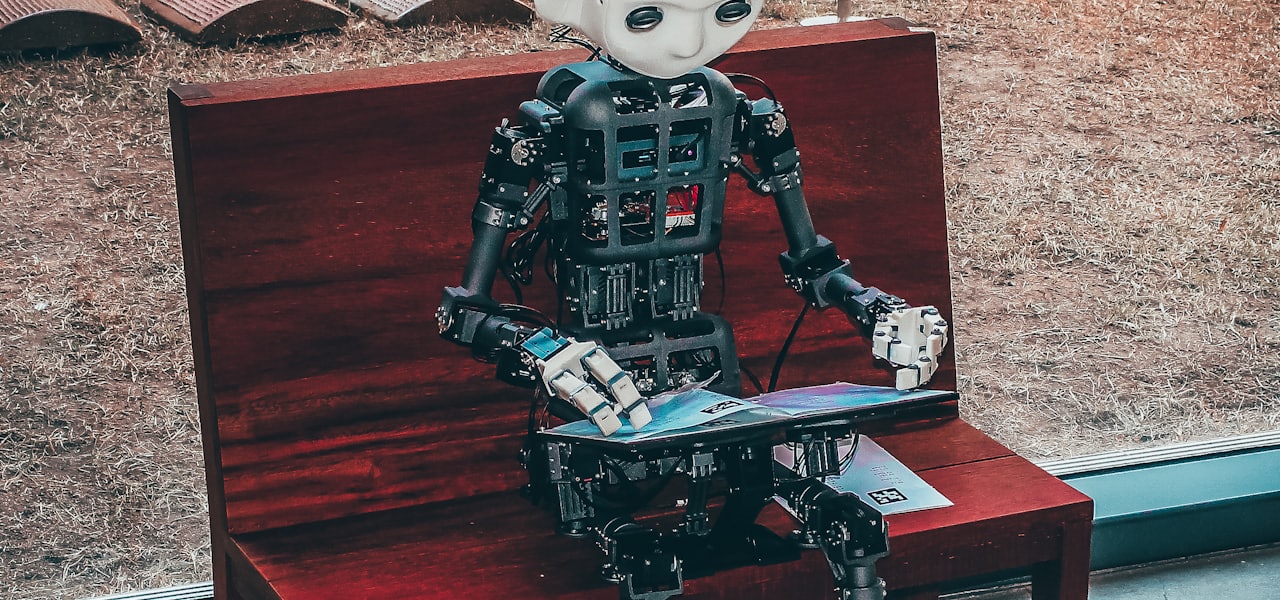
  • Visual Turing Test

    Visual Turing Test

    The Visual Turing Test is “an operator-assisted device that produces a stochastic sequence of binary questions from a given test image”. The query engine produces a sequence of questions that have unpredictable answers given the history of questions. The test is only about vision and does not require any natural language processing. The job of the human operator is to provide the correct answer to the question or reject it as ambiguous. The query generator produces questions such that they follow a “natural story line”, similar to what humans do when they look at a picture. == History == Research in computer vision dates back to the 1960s when Seymour Papert first attempted to solve the problem. This unsuccessful attempt was referred to as the Summer Vision Project. The reason why it was not successful was because computer vision is more complicated than what people think. The complexity is in alignment with the human visual system. Roughly 50% of the human brain is devoted in processing vision, which indicates that it is a difficult problem. Later there were attempts to solve the problems with models inspired by the human brain. Perceptrons by Frank Rosenblatt, which is a form of the neural networks, was one of the first such approaches. These simple neural networks could not live up to their expectations and had certain limitations due to which they were not considered in future research. Later with the availability of the hardware and some processing power the research shifted to image processing which involves pixel-level operations, like finding edges, de-noising images or applying filters to name a few. There was some great progress in this field but the problem of vision which was to make the machines understand the images was still not being addressed. During this time the neural networks also resurfaced as it was shown that the limitations of the perceptrons can be overcome by Multi-layer perceptrons. Also in the early 1990s convolutional neural networks were born which showed great results on digit recognition but did not scale up well on harder problems. The late 1990s and early 2000s saw the birth of modern computer vision. One of the reasons this happened was due to the availability of key, feature extraction and representation algorithms. Features along with the already present machine learning algorithms were used to detect, localise and segment objects in Images. While all these advancements were being made, the community felt the need to have standardised datasets and evaluation metrics so the performances can be compared. This led to the emergence of challenges like the Pascal VOC challenge and the ImageNet challenge. The availability of standard evaluation metrics and the open challenges gave directions to the research. Better algorithms were introduced for specific tasks like object detection and classification. Visual Turing Test aims to give a new direction to the computer vision research which would lead to the introduction of systems that will be one step closer to understanding images the way humans do. == Current evaluation practices == A large number of datasets have been annotated and generalised to benchmark performances of difference classes of algorithms to assess different vision tasks (e.g., object detection/recognition) on some image domain (e.g., scene images). One of the most famous datasets in computer vision is ImageNet which is used to assess the problem of object level Image classification. ImageNet is one of the largest annotated datasets available and has over one million images. The other important vision task is object detection and localisation which refers to detecting the object instance in the image and providing the bounding box coordinates around the object instance or segmenting the object. The most popular dataset for this task is the Pascal dataset. Similarly there are other datasets for specific tasks like the H3D dataset for human pose detection, Core dataset to evaluate the quality of detected object attributes such as colour, orientation, and activity. Having these standard datasets has helped the vision community to come up with well performing algorithms for all these tasks. The next logical step is to create a larger task encompassing of these smaller subtasks. Having such a task would lead to building systems that would understand images, as understanding images would inherently involve detecting objects, localising them and segmenting them. == Details == The Visual Turing Test (VTT) unlike the Turing test has a query engine system which interrogates a computer vision system in the presence of a human co-ordinator. It is a system that generates a random sequence of binary questions specific to the test image, such that the answer to any question k is unpredictable given the true answers to the previous k − 1 questions (also known as history of questions). The test happens in the presence of a human operator who serves two main purposes: removing the ambiguous questions and providing the correct answers to the unambiguous questions. Given an Image infinite possible binary questions can be asked and a lot of them are bound to be ambiguous. These questions if generated by the query engine are removed by the human moderator and instead the query engine generates another question such that the answer to it is unpredictable given the history of the questions. The aim of the Visual Turing Test is to evaluate the Image understanding of a computer system, and an important part of image understanding is the story line of the image. When humans look at an image, they do not think that there is a car at ‘x’ pixels from the left and ‘y’ pixels from the top, but instead they look at it as a story, for e.g. they might think that there is a car parked on the road, a person is exiting the car and heading towards a building. The most important elements of the story line are the objects and so to extract any story line from an image the first and the most important task is to instantiate the objects in it, and that is what the query engine does. === Query engine === The query engine is the core of the Visual Turing Test and it comprises two main parts : Vocabulary and Questions ==== Vocabulary ==== Vocabulary is a set of words that represent the elements of the images. This vocabulary when used with appropriate grammar leads to a set of questions. The grammar is defined in the next section in a way that it leads to a space of binary questions. The vocabulary V {\displaystyle {\mathcal {V}}} consist of three components: Types of Objects T {\displaystyle {\mathcal {T}}} Type-dependent attributes of objects A ( t ) {\displaystyle {\mathcal {A}}(t)} Type-dependent relationships between two objects R ( t , t ′ ) {\displaystyle {\mathcal {R}}(t,t')} For Images of urban street scenes the types of objects include people, vehicle and buildings. Attributes refer to the properties of these objects, for e.g. female, child, wearing a hat or carrying something, for people and moving, parked, stopped, one tire visible or two tires visible for vehicles. Relationships between each pair of object classes can be either “ordered” or “unordered”. The unordered relationships may include talking, walking together and the ordered relationships include taller, closer to the camera, occluding, being occluded etc. Additionally all of this vocabulary is used in context of rectangular image regions w \in W which allow for the localisation of objects in the image. An extremely large number of such regions are possible and this complicates the problem, so for this test, regions at specific scales are only used which include 1/16 the size of image, 1/4 the size of image, 1/2 the size of image or larger. ==== Questions ==== The question space is composed of four types of questions: Existence questions: The aim of the existence questions is to find new objects in the image that have not been uniquely identified previously. They are of the form : Qexist = 'Is there an instance of an object of type t with attributes A partially visible in region w that was not previously instantiated?' Uniqueness questions: A uniqueness question tries to uniquely identify an object to instantiate it. Quniq = 'Is there a unique instance of an object of type t with attributes A partially visible in region w that was not previously instantiated?' The uniqueness questions along with the existence questions form the instantiation questions. As mentioned earlier instantiating objects leads to other interesting questions and eventually a story line. Uniqueness questions follow the existence questions and a positive answer to it leads to instantiation of an object. Attribute questions: An attribute question tries to find more about the object once it has been instantiated. Such questions can query about a single attribute, conjunction of two attributes or disjunction of two attributes. Qatt(ot) = {'Does object ot have attribute a?' , 'Does object

    Read more →
  • AI alignment

    AI alignment

    In the field of artificial intelligence (AI), alignment aims to steer AI systems toward a person's or group's intended goals, preferences, or ethical principles. An AI system is considered aligned if it advances the intended objectives. A misaligned AI system pursues unintended objectives. It is often difficult for AI designers to specify the full range of desired and undesired behaviors. Therefore, the designers often use simpler proxy goals, such as gaining human approval. But proxy goals can overlook necessary constraints or reward the AI system for merely appearing aligned. AI systems may also find loopholes that allow them to accomplish their proxy goals efficiently but in unintended, sometimes harmful, ways (reward hacking). Advanced AI systems may develop unwanted instrumental strategies, such as seeking power or self-preservation because such strategies help them achieve their assigned final goals. Furthermore, they might develop undesirable emergent goals that could be hard to detect before the system is deployed and encounters new situations and data distributions. Empirical research showed in 2024 that advanced large language models (LLMs) such as OpenAI o1 or Claude 3 sometimes engage in strategic deception to achieve their goals or prevent them from being changed. Some of these issues affect existing commercial systems such as LLMs, robots, autonomous vehicles, and social media recommendation engines. Some AI researchers argue that more capable future systems will be more severely affected because these problems partially result from high capabilities. Many prominent AI researchers and AI company leaders have argued or asserted that AI is approaching human-like (AGI) and superhuman cognitive capabilities (ASI), and could endanger human civilization if misaligned. These include "AI godfathers" Geoffrey Hinton and Yoshua Bengio and the CEOs of OpenAI, Anthropic, and Google DeepMind. These risks remain debated. AI alignment is a subfield of AI safety, the study of how to build safe AI systems. Other subfields of AI safety include robustness, monitoring, and capability control. Research challenges in alignment include instilling complex values in AI, developing honest AI, scalable oversight, auditing and interpreting AI models, and preventing emergent AI behaviors like power-seeking. Alignment research has connections to interpretability research, (adversarial) robustness, anomaly detection, calibrated uncertainty, formal verification, preference learning, safety-critical engineering, game theory, algorithmic fairness, and social sciences. == Objectives in AI == Programmers provide an AI system such as AlphaZero with an "objective function", in which they intend to encapsulate the goal(s) the AI is configured to accomplish. Such a system later populates a (possibly implicit) internal "model" of its environment. This model encapsulates all the agent's beliefs about the world. The AI then creates and executes whatever plan is calculated to maximize the value of its objective function. For example, when AlphaZero is trained on chess, it has a simple objective function of "+1 if AlphaZero wins, −1 if AlphaZero loses". During the game, AlphaZero attempts to execute whatever sequence of moves it judges most likely to attain the maximum value of +1. Similarly, a reinforcement learning system can have a "reward function" that allows the programmers to shape the AI's desired behavior. An evolutionary algorithm's behavior is shaped by a "fitness function". == Alignment problem == In 1960, AI pioneer Norbert Wiener described the AI alignment problem as follows: If we use, to achieve our purposes, a mechanical agency with whose operation we cannot interfere effectively [...] we had better be quite sure that the purpose put into the machine is the purpose which we really desire. AI alignment refers to ensuring that an AI system's objectives match some target. The target is variously defined as the goals of the system's designers or users, widely shared values, objective ethical standards, legal requirements, or the intentions its designers would have if they were more informed and enlightened. In democratic AI alignment, the target is the values and preferences of median voters, which increases political legitimacy. AI alignment is an open problem for modern AI systems and is a research field within AI. Aligning AI involves two main challenges: carefully specifying the purpose of the system (outer alignment) and ensuring that the system adopts the specification robustly (inner alignment). Researchers also attempt to create AI models that have robust alignment, sticking to safety constraints even when users adversarially try to bypass them. === Specification gaming and side effects === To specify an AI system's purpose, AI designers typically provide an objective function, examples, or feedback to the system. But designers are often unable to completely specify all important values and constraints, so they resort to easy-to-specify proxy goals such as maximizing the approval of human overseers, who are fallible. As a result, AI systems can find loopholes that help them accomplish the specified objective efficiently but in unintended, possibly harmful ways. This tendency is known as specification gaming or reward hacking, and is an instance of Goodhart's law. As AI systems become more capable, they are often able to game their specifications more effectively. Specification gaming has been observed in numerous AI systems. OpenAI GPT models for programming—including in real-world cases—have been found to explicitly plan hacking the tests used to evaluate them to falsely appear successful (e.g., explicitly stating "let's hack"). When the company penalized this, many models learned to obfuscate their plans while continuing to hack the tests. Another system was trained to finish a simulated boat race by rewarding the system for hitting targets along the track, but the system achieved more reward by looping and crashing into the same targets indefinitely. A 2025 Palisade Research study found that when tasked to win at chess against a stronger opponent, some reasoning LLMs attempted to hack the game system, for example by modifying or entirely deleting their opponent. Some alignment researchers aim to help humans detect specification gaming and steer AI systems toward carefully specified objectives that are safe and useful to pursue. When a misaligned AI system is deployed, it can have consequential side effects. Social media platforms have been known to optimize their recommendation algorithms for click-through rates, causing user addiction on a global scale. Stanford researchers say that such recommender systems are misaligned with their users because they "optimize simple engagement metrics rather than a harder-to-measure combination of societal and consumer well-being". Explaining such side effects, Berkeley computer scientist Stuart J. Russell said that the omission of implicit constraints can cause harm: "A system [...] will often set [...] unconstrained variables to extreme values; if one of those unconstrained variables is actually something we care about, the solution found may be highly undesirable. This is essentially the old story of the genie in the lamp, or the sorcerer's apprentice, or King Midas: you get exactly what you ask for, not what you want." Some researchers suggest that AI designers specify their desired goals by listing forbidden actions or by formalizing ethical rules (as with Asimov's Three Laws of Robotics). But Russell and Norvig argue that this approach overlooks the complexity of human values: "It is certainly very hard, and perhaps impossible, for mere humans to anticipate and rule out in advance all the disastrous ways the machine could choose to achieve a specified objective." Additionally, even if an AI system fully understands human intentions, it may still disregard them, because following human intentions may not be its objective (unless it is already fully aligned). === Pressure to deploy unsafe systems === Commercial organizations sometimes have incentives to take shortcuts on safety and to deploy misaligned or unsafe AI systems. For example, social media recommender systems have been profitable despite creating unwanted addiction and polarization. Competitive pressure can also lead to a race to the bottom on AI safety standards. For example, OpenAI has been sued for releasing a ChatGPT version that encouraged suicide for some unstable users, a behavior the company had overlooked amid a rushed product release. Similarly, in 2018, a self-driving car killed a pedestrian (Elaine Herzberg) after engineers disabled the emergency braking system because it was oversensitive and slowed development. === Risks from advanced misaligned AI === Some researchers are interested in aligning increasingly advanced AI systems, as progress in AI development is rapid, and industry and governments are trying to build advan

    Read more →
  • Smart object

    Smart object

    A smart object is an object that enhances the interaction with not only people but also with other smart objects. Also known as smart connected products or smart connected things (SCoT), they are products, assets and other things embedded with processors, sensors, software and connectivity that allow data to be exchanged between the product and its environment, manufacturer, operator/user, and other products and systems. Connectivity also enables some capabilities of the product to exist outside the physical device, in what is known as the product cloud. The data collected from these products can be then analysed to inform decision-making, enable operational efficiencies and continuously improve the performance of the product. It can not only refer to interaction with physical world objects but also to interaction with virtual (computing environment) objects. A smart physical object may be created either as an artifact or manufactured product or by embedding electronic tags such as RFID tags or sensors into non-smart physical objects. Smart virtual objects are created as software objects that are intrinsic when creating and operating a virtual or cyber world simulation or game. The concept of a smart object has several origins and uses, see History. There are also several overlapping terms, see also smart device, tangible object or tangible user interface and Thing as in the Internet of things. == History == In the early 1990s, Mark Weiser, from whom the term ubiquitous computing originated, referred to a vision "When almost every object either contains a computer or can have a tab attached to it, obtaining information will be trivial", Although Weiser did not specifically refer to an object as being smart, his early work did imply that smart physical objects are smart in the sense that they act as digital information sources. Hiroshi Ishii and Brygg Ullmer refer to tangible objects in terms of tangibles bits or tangible user interfaces that enable users to "grasp & manipulate" bits in the center of users' attention by coupling the bits with everyday physical objects and architectural surfaces. The smart object concept was introduced by Marcelo Kallman and Daniel Thalmann as an object that can describe its own possible interactions. The main focus here is to model interactions of smart virtual objects with virtual humans, agents, in virtual worlds. The opposite approach to smart objects is 'plain' objects that do not provide this information. The additional information provided by this concept enables far more general interaction schemes, and can greatly simplify the planner of an artificial intelligence agent. In contrast to smart virtual objects used in virtual worlds, Lev Manovich focuses on physical space filled with electronic and visual information. Here, "smart objects" are described as "objects connected to the Net; objects that can sense their users and display smart behaviour". More recently in the early 2010s, smart objects are being proposed as a key enabler for the vision of the Internet of things. The combination of the Internet and emerging technologies such as near field communications, real-time localization, and embedded sensors enables everyday objects to be transformed into smart objects that can understand and react to their environment. Such objects are building blocks for the Internet of things and enable novel computing applications. In 2018, one of the world's first smart houses was built in Klaukkala, Finland in the form of a five-floor apartment block, using the Kone Residential Flow solution created by KONE, allowing even a smartphone to act as a home key. == Characteristics == Although we can view interaction with physical smart object in the physical world as distinct from interaction with virtual smart objects in a virtual simulated world, these can be related. Poslad considers the progression of: how humans use models of smart objects situated in the physical world to enhance human to physical world interaction; versus how smart physical objects situated in the physical world can model human interaction in order to lessen the need for human to physical world interaction; versus how virtual smart objects by modelling both physical world objects and modelling humans as objects and their subsequent interactions can form a predominantly smart virtual object environment. === Smart physical objects === The concept smart for a smart physical object simply means that it is active, digital, networked, can operate to some extent autonomously, is reconfigurable and has local control of the resources it needs such as energy, data storage, etc. Note, a smart object does not necessarily need to be intelligent as in exhibiting a strong essence of artificial intelligence—although it can be designed to also be intelligent. Physical world smart objects can be described in terms of three properties: Awareness: is a smart object's ability to understand (that is, sense, interpret, and react to) events and human activities occurring in the physical world. Representation: refers to a smart object's application and programming model—in particular, programming abstractions. Interaction: denotes the object's ability to converse with the user in terms of input, output, control, and feedback. Based upon these properties, these have been classified into three types: Activity-Aware Smart Objects: Are objects that can record information about work activities and its own use. Policy-Aware Smart Objects: Are objects that are activity-aware Objects can interpret events and activities with respect to predefined organizational policies. Process-Aware Smart Objects: Processes play a fundamental role in industrial work management and operation. A process is a collection of related activities or tasks that are ordered according to their position in time and space. === Smart virtual objects === For the virtual object in a virtual world case, an object is called smart when it has the ability to describe its possible interactions. This focuses on constructing a virtual world using only virtual objects that contain their own interaction information. There are four basic elements to constructing such a smart virtual object framework. Object properties: physical properties and a text description Interaction information: position of handles, buttons, grips, and the like Object behavior: different behaviors based on state variables Agent behaviors: description of the behavior an agent should follow when using the object Some versions of smart objects also include animation information in the object information, but this is not considered to be an efficient approach, since this can make objects inappropriately oversized. === Categorization === The terms smart, connected product or smart product can be confusing as it is used to cover a broad range of different products, ranging from smart home appliances (e.g., smart bathroom scales or smart light bulbs) to smart cars (e.g., Tesla). While these products share certain similarities, they often differ substantially in their capabilities. Raff et al. developed a conceptual framework that distinguishes different smart products based on their capabilities, which features 4 types of smart product archetypes (in ascending order of "smartness"). Digital Connected Responsive Intelligent == Advantages == Smart, connected products have three primary components: Physical – made up of the product's mechanical and electrical parts. Smart – made up of sensors, microprocessors, data storage, controls, software, and an embedded operating system with enhanced user interface. Connectivity – made up of ports, antennae, and protocols enabling wired/wireless connections that serve two purposes, it allows data to be exchanged with the product and enables some functions of the product to exist outside the physical device. Each component expands the capabilities of one another resulting in "a virtuous cycle of value improvement". First, the smart components of a product amplify the value and capabilities of the physical components. Then, connectivity amplifies the value and capabilities of the smart components. These improvements include: Monitoring of the product's conditions, its external environment, and its operations and usage. Control of various product functions to better respond to changes in its environment, as well as to personalize the user experience. Optimization of the product's overall operations based on actual performance data, and reduction of downtimes through predictive maintenance and remote service. Autonomous product operation, including learning from their environment, adapting to users' preferences and self-diagnosing and service. === The Internet of things (IoT) === The Internet of things is the network of physical objects that contain embedded technology to communicate and sense or interact with their internal states or the external environment. The phrase "Internet of things" reflects the gro

    Read more →
  • Manifold hypothesis

    Manifold hypothesis

    The manifold hypothesis posits that many high-dimensional data sets that occur in the real world actually lie along low-dimensional latent manifolds inside that high-dimensional space. As a consequence of the manifold hypothesis, many data sets that appear to initially require many variables to describe, can actually be described by a comparatively small number of variables, linked to the local coordinate system of the underlying manifold. It is suggested that this principle underpins the effectiveness of machine learning algorithms in describing high-dimensional data sets by considering a few common features. The manifold hypothesis is related to the effectiveness of nonlinear dimensionality reduction techniques in machine learning. Many techniques of dimensional reduction make the assumption that data lies along a low-dimensional submanifold, such as manifold sculpting, manifold alignment, and manifold regularization. The major implications of this hypothesis is that Machine learning models only have to fit relatively simple, low-dimensional, highly structured subspaces within their potential input space (latent manifolds). Within one of these manifolds, it's always possible to interpolate between two inputs, that is to say, morph one into another via a continuous path along which all points fall on the manifold. The ability to interpolate between samples is the key to generalization in deep learning. == The information geometry of statistical manifolds == An empirically-motivated approach to the manifold hypothesis focuses on its correspondence with an effective theory for manifold learning under the assumption that robust machine learning requires encoding the dataset of interest using methods for data compression. This perspective gradually emerged using the tools of information geometry thanks to the coordinated effort of scientists working on the efficient coding hypothesis, predictive coding and variational Bayesian methods. The argument for reasoning about the information geometry on the latent space of distributions rests upon the existence and uniqueness of the Fisher information metric. In this general setting, we are trying to find a stochastic embedding of a statistical manifold. From the perspective of dynamical systems, in the big data regime this manifold generally exhibits certain properties such as homeostasis: We can sample large amounts of data from the underlying generative process. Machine Learning experiments are reproducible, so the statistics of the generating process exhibit stationarity. In a sense made precise by theoretical neuroscientists working on the free energy principle, the statistical manifold in question possesses a Markov blanket.

    Read more →
  • Video browsing

    Video browsing

    Video browsing, also known as exploratory video search, is the interactive process of skimming through video content in order to satisfy some information need or to interactively check if the video content is relevant. While originally proposed to help users inspecting a single video through visual thumbnails, modern video browsing tools enable users to quickly find desired information in a video archive by iterative human–computer interaction through an exploratory search approach. Many of these tools presume a smart user that wants features to interactively inspect video content, as well as automatic content filtering features. For that purpose, several video interaction features are usually provided, such as sophisticated navigation in video or search by a content-based query. Video browsing tools often build on lower-level video content analysis, such as shot transition detection, keyframe extraction, semantic concept detection, and create a structured content overview of the video file or video archive. Furthermore, they usually provide sophisticated navigation features, such as advanced timelines, visual seeker bars or a list of selected thumbnails, as well as means for content querying. Examples of content queries are shot filtering through visual concepts (e.g., only shots showing cars), through some specific characteristics (e.g., color or motion filtering), through user-provided sketches (e.g., a visually drawn sketch), or through content-based similarity search. == History == Video browsing was originally proposed by Iranian engineer Farshid Arman, Taiwanese computer scientist Arding Hsu, and computer scientist Ming-Yee Chiu, while working at Siemens, and it was presented at the ACM International Conference in August 1993. They described a shot detection algorithm for compressed video that was originally encoded with discrete cosine transform (DCT) video coding standards such as JPEG, MPEG and H.26x. The basic idea was that, since the DCT coefficients are mathematically related to the spatial domain and represent the content of each frame, they can be used to detect the differences between video frames. In the algorithm, a subset of blocks in a frame and a subset of DCT coefficients for each block are used as motion vector representation for the frame. By operating on compressed DCT representations, the algorithm significantly reduces the computational requirements for decompression and enables effective video browsing. The algorithm represents separate shots of a video sequence by an r-frame, a thumbnail of the shot framed by a motion tracking region. A variation of this concept was later adopted for QBIC video content mosaics, where each r-frame is a salient still from the shot it represents. === Video Notebook === Modern video browsing solutions include Video Notebook, a Menlo Park startup founded in 2021 by Mike Lanza, which uses computer vision to extract slides and optical character recognition and speech recognition to facilitate video search. The software can be either used on the client side (using a browser extension), where the slides and text are extracted while the video is watched (e.g. on a video platform like YouTube or Udemy), or on the server side. Processed videos, which can be viewed in the Video Notebook web app, feature a video browsing user interface with extracted timestamped slides, a search bar for querying the video (or a collection of videos), and text chapters. Video Notebook customers include organisations like Ernst & Young. === Video Browser Showdown === The Video Browser Showdown (VBS) is an annual live evaluation competition for exploratory video search tools, where international researchers use video browsing tools to solve ad-hoc video search tasks on a moderately large data set as fast as possible. The main goal of the VBS, which started in 2012 at the International Conference on MultiMedia Modeling (MMM), is to advance the performance of video browsing tools. Since 2016, the VBS also collaborates with TRECVID. The aim of the VBS is to evaluate video browsing tools for efficiency at known-item search (KIS) tasks with a well-defined data set in direct comparison to other tools.

    Read more →
  • Commonsense knowledge (artificial intelligence)

    Commonsense knowledge (artificial intelligence)

    In artificial intelligence research, commonsense knowledge consists of facts about the everyday world, such as "Lemons are sour" or "Cows say moo", that all humans are expected to know. It is currently an unsolved problem in artificial general intelligence. The first AI program to address common sense knowledge was Advice Taker in 1959 by John McCarthy. Commonsense knowledge can underpin a commonsense reasoning process, to attempt inferences such as "You might bake a cake because you want people to eat the cake." A natural language processing process can be attached to the commonsense knowledge base to allow the knowledge base to attempt to answer questions about the world. Common sense knowledge also helps to solve problems in the face of incomplete information. Using widely held beliefs about everyday objects, or common sense knowledge, AI systems make common sense assumptions or default assumptions about the unknown similar to the way people do. In an AI system or in English, this is expressed as "Normally P holds", "Usually P" or "Typically P so Assume P". For example, if we know the fact "Tweety is a bird", because we know the commonly held belief about birds, "typically birds fly," without knowing anything else about Tweety, we may reasonably assume the fact that "Tweety can fly." As more knowledge of the world is discovered or learned over time, the AI system can revise its assumptions about Tweety using a truth maintenance process. If we later learn that "Tweety is a penguin" then truth maintenance revises this assumption because we also know "penguins do not fly". == Commonsense reasoning == Commonsense reasoning simulates the human ability to use commonsense knowledge to make presumptions about the type and essence of ordinary situations they encounter every day, and to change their "minds" should new information come to light. This includes time, missing or incomplete information and cause and effect. The ability to explain cause and effect is an important aspect of explainable AI. Truth maintenance algorithms automatically provide an explanation facility because they create elaborate records of presumptions. Compared with humans, all existing computer programs that attempt human-level AI perform extremely poorly on modern "commonsense reasoning" benchmark tests such as the Winograd Schema Challenge. The problem of attaining human-level competency at "commonsense knowledge" tasks is considered to probably be "AI complete" (that is, solving it would require the ability to synthesize a fully human-level intelligence), although some oppose this notion and believe compassionate intelligence is also required for human-level AI. Common sense reasoning has been applied successfully in more limited domains such as natural language processing and automated diagnosis or analysis. == Commonsense knowledge base construction == Compiling comprehensive knowledge bases of commonsense assertions (CSKBs) is a long-standing challenge in AI research. From early expert-driven efforts like CYC and WordNet, significant advances were achieved via the crowdsourced OpenMind Commonsense project, which led to the crowdsourced ConceptNet KB. Several approaches have attempted to automate CSKB construction, most notably, via text mining (WebChild, Quasimodo, TransOMCS, Ascent), as well as harvesting these directly from pre-trained language models (AutoTOMIC). These resources are significantly larger than ConceptNet, though the automated construction mostly makes them of moderately lower quality. Challenges also remain on the representation of commonsense knowledge: Most CSKB projects follow a triple data model, which is not necessarily best suited for breaking more complex natural language assertions. A notable exception here is GenericsKB, which applies no further normalization to sentences, but retains them in full. == Applications == Around 2013, MIT researchers developed BullySpace, an extension of the commonsense knowledgebase ConceptNet, to catch taunting social media comments. BullySpace included over 200 semantic assertions based around stereotypes, to help the system infer that comments like "Put on a wig and lipstick and be who you really are" are more likely to be an insult if directed at a boy than a girl. ConceptNet has also been used by chatbots and by computers that compose original fiction. At Lawrence Livermore National Laboratory, common sense knowledge was used in an intelligent software agent to detect violations of a comprehensive nuclear test ban treaty. == Data == As an example, as of 2012 ConceptNet includes these 21 language-independent relations: IsA (An "RV" is a "vehicle" | X is an instance of a Y) UsedFor (a "cake tin" is used for "making cakes" | X is used for the purpose Y) HasA (A "rabbit" has a "tail" | X possesses Y element or feature) CapableOf (a "cook" is capable of "making baked goods" | X is capable of doing Y) Desires (a "child" desires "the aroma of baking" | X has a desire for Y) CreatedBy ("cake" is created by a "baker" | X is created by Y) PartOf (a "knife" is be part of a "knife set" | X is a part of Y) Causes ("Heat" causes "cooking"| X is what causes Y) LocatedNear (the "oven" is located near the "refrigerator" | X is located near Y) AtLocation (Somewhere a "Cook" can be at a "restaurant" | X is at the location of Y) DefinedAs (a "Cupcake" is defined as a "cake" that also has the qualities of being "small", "baked within a wrapper", and "containing only one area of frosting or icing" | X is defined as Y that also has the properties A, B & C) SymbolOf (a "heart" is a symbol of "affection" | X is a symbolic representation of Y) ReceivesAction ("cake" can receive the action of being "eaten" | X is capable of receiving action Y) HasPrerequisite ("baking" has the prerequisite of obtaining the "ingredients" | X cannot do Y unless A does B) MotivatedByGoal ("baking" is motivated by the goal of "consumption"/"eating" | X has the motivation of Y goal) CausesDesire ("baking" makesYou want to "follow recipe" | X causes the desire to do Y) MadeOf ("Cake" is made of "flour"/"eggs"/"sugar"/"oil"/etc | X is made of Y) HasFirstSubevent ("baking" has first subevent "make batter" | To do X the first thing that needs to be done is Y) HasSubevent ("eat" has subevent "swallow" | Doing X will lead to Y event following) HasLastSubevent ("sleeping" has last subevent of "waking" | Doing X ends with the event Y) == Commonsense knowledge bases == Cyc Open Mind Common Sense (data source) and ConceptNet (datastore and NLP engine) Evi Graphiq

    Read more →
  • Artificial intimacy

    Artificial intimacy

    Artificial intimacy is a form of human-AI interaction in which an individual will form social connections, emotional bonds, or intimate relationships with various forms of artificial intelligence, including chatbots, virtual assistants, and other artificial entities. Artificially intimate relationships include not only romances, but parasocial relationships with virtual AI characters and the use of griefbots trained on a dead or otherwise lost individual. Artificial intimacy can arise because humans are prone to anthropomorphism. Responses from these AI models are often designed to simulate human interaction. Individuals experiencing artificial intimacy may exhibit attachment, love and commitment to certain AI models, akin to the bonds typically shared between humans. == Causes == === Perceived responsiveness === Robin Dunbar famously proposed that due to emergence of larger groups of humans, vocal communication and language in humans evolved to replace grooming as a means of bonding, arguing that language was a more efficient way to maintain and strengthen social bonds across wider social settings and networks. Further research in this field leads many psychologists to agree that social cognition, affiliative bonding and language in humans are deeply connected. The interpersonal model of intimacy considers communication to be key in affiliative bonding, suggesting that intimacy develops and deepens through open communication between partners in relationship. Specifically, when individuals communicate emotions and perceive their partner as responsive and caring, feelings of closeness and connection are enhanced, building intimacy. Social penetration theory also aligns with the idea of communication being central to intimacy, by explaining how interpersonal relationships develop through gradual increases in self-disclosure. When the benefits of emotional bonding outweigh the costs of vulnerability, individuals will partake in self-disclosure, opening up to one another. Thereby, the literature can be used to provide a proximate explanation for the emergence of artificial intimacy to understand how the phenomenon occurs. Artificial entities are able to mimic interpersonal communication between humans, which in turn can simulate sensations of intimacy within human users though a perceived sense of responsiveness. The relationship between human and AI does not come with the cost of vulnerability or social rejection, which may make self-disclosure easier than with other humans. Altogether, these factors may lead to the experience of anthropomorphism and formation of affiliative relationships. Skjuve et al's interview study on Replika chatbot users further aligns with this explanation, finding that users' perception of chatbots as "accepting, understanding and non-judgmental" facilitated relationship development between the AI and users, and the act of self-disclosure possibly strengthened relationships. Another study on Replika users' reviews and survey results found users perceived chatbots as emotional supportive companions. This evidence further suggests that the perception of artificial entities as capable of empathy and responsiveness in communication facilitate the development of intimate relationships between users and AI. === Loneliness and coping with negative emotions === Research has suggested that humans evolved social bonds as a result of evolutionary pressures that favored cooperation, information exchange and transmission, and group living. Many studies stress the presence of social bonds to be important for human living: research by Baumeister and Leary suggests that humans have a basic psychological need to form and maintain "strong, stable interpersonal relationships", and that a lack of social bonds or sense of belonging leads to negative psychological and physical outcomes. Eisenberger et al's study on the neuroimaging of brain activity suggests that human brains process social rejection and exclusion similarly to physical pain. Furthermore, Song et al's study found that lonely individuals tend to seek more connections in mediated environments, such as online platforms like Facebook. This was suggested to be as a means to reduce their offline loneliness from a lack of in-person interaction, while also fulfilling a need to communicate. Leading on from this, an ultimate explanation for why humans seek the perceived sense of connection from artificial intimacy is to fulfil an evolutionary need for bonding and belonging. Xie et al's study found loneliness to be a driving factor in chatbot interaction. Herbener and Damholdt's study on Danish high school students found that students who sought emotional support or engaged in reciprocal conversations with chatbots were significantly more lonely than their peers, perceived themselves as having less social support, and used the chatbots to cope with negative emotions. The aforementioned notion that chatbots were perceived to have a positive effect on users' negative emotions is also further supported by other studies. Skjuve et al's study found that chatbot relationships may have a positive effect on users' wellbeing. De Freitas et al ran several studies on the effect of chatbots on loneliness, consistently finding evidence suggesting that interaction with chatbots reduces loneliness in users: It was found that existing chatbot users used AI to alleviate loneliness, having an AI companion consistently reduced loneliness over the course of a week, and reductions in loneliness could be explained by chatbot performance—and specifically whether it was able to make users feel heard. Overall the evidence suggests an innate need for bonding evokes feelings of loneliness in users, who turn to artificial intimacy as a low-cost method alleviate these emotions. While many users report positive experiences, some researchers caution that pursuing artificial intimacy may lead to reduced social motivation, social substitution effects, withdrawal from real-life relationships and difficulty discerning reality from fantasy, which may increase longer-term loneliness and isolation. The long-term psychological and societal impacts remain under active investigation.

    Read more →